It looks like this will never be published on UWire.com, so I'll put it on here.
====================
Piling Up the (Campus) Pork
By Kevin Bunkley
Pork has a special place in the backrooms of Washington, D.C. -- and it isn't at the front of the buffet table. It finds its way into the back pockets of nearly every politician on Capitol Hill, and now it's coming to your dormitory. Rep. John Murtha (R-PA), who is notorious for getting pork projects for his home district for defense contractors, has now managed to bring some pork to a college campus -- his alma mater, Indiana University of Pennsylvania. The Washington Post reported on a $53 million earmarked project to build a new facility to house the Murtha Institute, a group that has no mandate whatsoever for what it should use this money for.
State Universities, places that one would think are above shady political practices, are starting to get thousands of pork projects appropriated to them for the strangest of projects. Higher education has no room for federal earmarks that do nothing -- it only makes the best secondary education system in the world look as corrupt and inept as the politicians who give them the money. University Boards of Regents and Presidents are above this, and should not let Washington politics get in the way of following their own ethics. College campuses get federal funding -- our tax dollars -- to give an education, not give a few close friends of a Senator or Congressman some new digs to push paper around in.
Earmarks are not inherently bad in theory, because there have been some useful earmarks approved by Congress. The University of Michigan received millions for a new children's hospital, energy research, and cancer research. To end those would of course be foolish. It's getting easier and easier, however, for members of Congress to drum up support for the more silly of projects among their constituents because it is money for their district, and that usually means jobs. Pork projects, on the other hand, have no public benefit, and for one thing, the categorization of these grants should be designated as such. Voters may not be so keen on giving a university a million dollars to study textiles when there is no direct university involvement in such an industry.
The types of projects that are penetrating college campuses range from the stupid ($800,000 for oyster rehabilitation in Alabama), to strange ($196,000 for reducing pig odors and waste), and to the self-promoting (Sen Charles D. Rangel (D-NY) got funding for a Public Service center named after himself). And there are thousands more just like those. These are attached to the useful higher education funding bills, and almost always pass because, who wants to be scrutinized for voting against funding such a thing as a college? Certainly not an elected official.
The Chronicle for Higher Education's 2008 report on higher education earmarks says that it was at its highest total ever, at $2.3 billion. In 1990 it was a mere $270 million. It can only go up without any oversight or control. Congress must take a hard look at what's being lobbied for, and prioritize according to merit, not personal influence of high-ranking committee chairs or even alumni. During the 2008 campaign, McCain, Obama, and Clinton wanted a moratorium on earmark legislation, but of course a problem presented itself: the vote was thirty-one shy of a majority, so the legislation to end stupid legislation died on the Senate floor. Fix it by forcing Senators and members of Congress to add any and all earmarks they voted for, in addition to ones they introduced, to their public disclosures of all financial information. It would certainly give me pause if I learned that my Congressman had pushed through $80 million in projects to a university in my state, as Sen. Thad Cochran of Mississippi did for his home state. Why are our elected officials given a pass for something like that just because it's "helping" higher education in their home state?
Universities are as much to blame as the Congressman and Senators who get the earmarks. Most major universities have lobbying offices in Washington, D.C., off Capitol Hill, with the explicit purpose of getting this money. Some use it to get meaningful projects, like medical research or automobile research, or IT development, and others, in Indiana-Penn's case, use it to create shell organizations with no real benefit to their campus community or the country. A true crackdown on abuse of lobbying influence is simply yanking federal funding from universities that are building more "Murtha Institutes." A university has every right to lobby the federal government for money or help on issues, but isn't it a little dishonest to use that influence to directly lobby a member of Congress, specifically because they don't have to submit their research proposals to third-party NGOs that present them to review panels? Such a glaring loophole is a direct result of to much power given to a Senator or Congressman. When a powerful member like Murtha or Rangel proposes such a wasteful use of money, his committee must have the sense to vote to strip him of his chairmanship.
If Sen. Ted Stevens (R-AL) can get $986,000 for berry research at The University of Alaska-Fairbanks, then there are some serious loopholes in the way our colleges and universities are funded. Someone like Senator McCain could put some real pressure on all his friends if he re-introduced that bill for a moratorium on earmarks to universities with the stipulation that those who do not vote for it face having their earmark voting record disclosed to the public. It's political blackmail, but it's no different than others blackmailing voters into supporting such wastes of money by advertising that it's good for higher education. America prides itself on having the finest secondary education system in the world, and that image is disappearing faster than the pig stench in Iowa that got more money than some whole schools did.
Universities and our government are equally guilty, but universities in particular can take the high ground and eliminate the middleman. Carefully read the legislation, and refuse to lobby for anything with pork attached. And when the request for funding dies in the House or Senate, the universities are exempt from scrutiny and blame gets put squarely on the politician for letting a higher education bill fail because it didn't benefit them in any way. The loophole of no peer review for bills brought in by specific members of Congress has to be closed, for the sake of preserving what earmarks are for: us. Universities wouldn't be good at anything without them, but it's quickly destroying the image of a university as this infallible public institution, and lumping it exactly where it shouldn't be: in the same boat as our Congress. The merit of an American college degree will soon be lower than their approval ratings should this problem go unattended.
25 October 2009


19 October 2009
Nobody Does it Better
Came a feature story in the Washington Post on Sunday: one of those rare times when Bob Woodward does actual reporting instead of getting in everyone's back pocket to get fodder for whatever book he's writing. Thank goodness the Bush administration is no longer around, too, otherwise he would be sidetracked writing a fifth Bush expose !
Woodward and Gordon M. Goldstein have combined some interviews they did a long time ago with Robert S. McNamara, and MacGeorge Bundy, each prior to the mens' deaths. It's a detailed explanation of the internal debates over Vietnam, and it's definitely done with the present situation in Afghanistan in mind.
"The Anguish of Decision" (note that the print version of this story had a great photo of President Johnson & McNamara seated next to each other, both with expressions of total exhaustion and mental conflict on their faces.
Woodward and Gordon M. Goldstein have combined some interviews they did a long time ago with Robert S. McNamara, and MacGeorge Bundy, each prior to the mens' deaths. It's a detailed explanation of the internal debates over Vietnam, and it's definitely done with the present situation in Afghanistan in mind.
"The Anguish of Decision" (note that the print version of this story had a great photo of President Johnson & McNamara seated next to each other, both with expressions of total exhaustion and mental conflict on their faces.
13 October 2009
Obama's War

PBS just wowed me with the season premiere of "Frontline."
In the book "The Gamble," by Thomas Ricks, the final section was called "Obama's War," hinting that in his view, President Obama's national security legacy hinged not on success in Iraq but success in Afghanistan.
After watching this program just now, I couldn't agree with that sentiment more.
It focused mainly on the challenges of the new counter-insurgency strategy developed by General Petraeus, and the issues with Pakistan. They had an embedded war correspondent following a unit in the Helmund Province, one of the areas that General McChrystal would like more troops sent to to interact with the local populace and force the Taliban out of hiding.
The whole (!!) program is available online right now, and they have some other goodies on their website.
My man Steve Coll was interviewed (his blog can also be read on The New Yorker site), much to my delight, as well as top ambassadors, generals, and regional experts.
"Frontline" is one of those programs where I go, "WOW, this is on PBS!!" and it proves the worth of public broadcasting and radio, exponentially.
09 October 2009
Things That Make The World Explode
Figuratively speaking.
In under 14 hours, both the American media and the international media have exploded over President Obama's receipt of the Nobel Peace Prize.
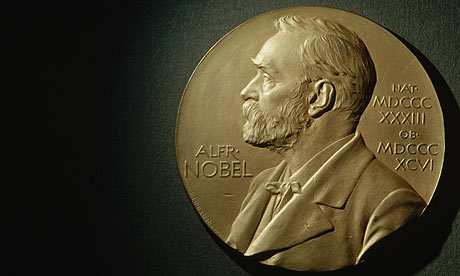
Obama, at the Rose Garden, said in essence:
In under 14 hours, both the American media and the international media have exploded over President Obama's receipt of the Nobel Peace Prize.
Obama, at the Rose Garden, said in essence:
I will accept this award as a call to action, a call for all nations and all peoples to confront the common challenges of the 21st century. These challenges won't all be met during my presidency, or even my lifetime. But I know these challenges can be met so long as it's recognized that they will not be met by one person or one nation alone.
NPR aired Rush Limbaugh's comment during their hourly news updates, in which Limbaugh said Obama's award was a bigger embarrassment than Chicago losing the Olympics bid.
But how much do we really know?
The Nobel Committee is a majority of liberal politicians, but international peace is kind of de facto liberalism to me anyways. The Norwegian government elects each member of the Nobel Committee, and, politically, it's about on par with the British Labour Party, not the American Democratic Party. If Obama were a British politician in the 1990s before Tony Blair, he never would have had a chance in hell.
Obama has lofty goals for his Presidency, and if he meets half of them, he deserved this award. The one that sticks out to me is his push for the elimination of nuclear weapons. That's on par with Woodrow Wilson's creation of the League of Nations. Times two.
This isn't about politics. It's about a vision for the world. A commentator on NPR's website said that Obama owes George Bush for this award because Bush screwed up America's image so much that it was a cakewalk for Mr. Obama to give a few speeches and suddenly be given a Nobel Prize.
Fox News, the bastion of intellect, put an op/ed on their website diminishing the Nobel Prize down to a laundry list of photo ops and speeches.
It's remarkable that Obama won for his vision for the world, and I'll be curious to see if a journalist ever gets ahold of the "portfolio" that the Committee referred to when making it's selection.
Obviously, they saw the same thing that a majority of Americans saw on November 8th.
I'm just sitting back and watching a sitting American President win one of the most prestigious things in existence for the first time in 90 years. If anything, reduce it to that, and you'll all feel better.
I wonder though, should Obama have declined the award??
No. He did the right thing in using it as an impetus to continue his work. However, it remains to be seen what he will do with the large sum of money he gets along with the award. He should donate it to one of the foundations that helps families of fallen soldiers, or something similar.
I wonder though, should Obama have declined the award??
No. He did the right thing in using it as an impetus to continue his work. However, it remains to be seen what he will do with the large sum of money he gets along with the award. He should donate it to one of the foundations that helps families of fallen soldiers, or something similar.
05 October 2009
Before I left Ann Arbor...
I wrote a little column for a tiny little publication called Consider Magazine.
It was published today, have a look. I previously posted a few drafts of this piece, but it looks fancier on the website.
http://consideronline.org/2009/10/05/has-google-become-too-big/
It was published today, have a look. I previously posted a few drafts of this piece, but it looks fancier on the website.
http://consideronline.org/2009/10/05/has-google-become-too-big/
Subscribe to:
Posts (Atom)

