On the heels of the Washington Post's investigation into the intelligence community our government has come to depend on, comes another nugget that fell into the laps of The New York Times, The Guardian, and Germany's Der Spiegel. It's being called "The War Logs," or, "The Afghan War Diary," and there's been a big surge in media coverage to interpret this sudden release.
A note on WikiLeaks. MotherJones has a feature story in their August issue called "Click and Dagger," in which it does make mention of the Pentagon Papers, and it's just ironic that the site got its own version of those documents:
It took nearly two years for Daniel Ellsberg to get the Pentagon Papers into the public domain. "As a leak, it's almost an example of what not to do," says [founder Julian] Assange. "By the time he got the info out, it was of little political consequence." The basic model hasn't changed much since then: Most whistleblowers still need a sympathetic reporter or politician to get the word out.
There is a warning in that paragraph for the present situation. The political consequence of this Afghan Diary might be too little too late, because, as The White House was quick to point out, the details of these documents refers to a time period prior to President Obama's decision to both call a three month policy review and send 30,000 additional combat troops. And what's missing? There was no reporter that these documents were leaked to, no face to put it in print. Today The White House elaborated on the leak at the press conference, saying it could do "potential harm" to the war and relations with Pakistan.
The War Logs, and subsequently, the specific documents that number 92,000+ (note that there appears to be an agreement between WikiLeaks and the three publications to not publish their respective stories/investigations at the same time, nor can they have access to all the documents right away) are not an indictment of a failed military operation that has lasted nine years. I think the aim of the anonymous leaker was to get hard information about what has happened so far out into the open. Many publications have deep access to the US military, but rarely do they get physical information that identifies operations that have taken place deep in the mountains of Pakistan, and how difficult maintaining order within the regions of Afghanistan really has been.
Many have already said, either on Twitter or on blogs or in print, that these are most decidedly not the Pentagon Papers of this war. At first glance of some of the substance of the documents, it gives names, places, and other things that appear top secret, but maybe that's in the eye of the beholder. I'm sure Pakistan would not like some of what is in there, and there's always potential to miss something and have some name get out that wasn't supposed to, and endanger someone's life. The Pentagon Papers were about proving to America that its adventure in Vietnam was not worth the cost in blood it had paid. The papers were released at the tail end of combat operations, so there was not much that could be done to reverse the policy. It was a first-hand account of the government's thinking, and gave hard evidence to the long-held suspicion that American officials did not think the Vietnam War could be won. There is a stark difference between learning that you've been lied to by your government, and learning that your government and its military has been up to far more than was originally told. It's like finding out your high school teachers actually had lives outside the school during the summer.
The primary effect of this Afghan War Diary is one of transparency, not shock. We know what the grand plan for Afghanistan is, and we know what the President wants to accomplish. There isn't a whole lot of discrepancy towards the endgame, and the reason we're still there is because the administration implicated in these very documents did not fully understand the hornet's nest they were poking with the biggest of sticks, the US military, but this isn't a indictment of the overall strategy. The Obama administration might be concerned about how the public interprets this event, but I say bring it on. Too many don't believe in absolutes, and Afghanistan is an absolute, and it took an anonymous leak of things we already know to get it back into the conversation. I'm hopeful to see how journalists go forward with this information.
26 July 2010


05 July 2010
I Have Not Yet Begun to Fight!
I've published another piece on The US Naval Memorial's blog...the site doesn't appear to be working correctly so I pasted the piece below:
America's First Naval Hero
by Kevin Bunkley
Fireworks go with our Independence Day like peanut butter with jelly, but the American Navy during the Revolutionary War made what I consider to be the America's first display of naval firepower.
The Continental Navy, the third of the original three branches of service (Continental Army and Marines were the others), was arguably the most vital to keeping the machine of revolution lubricated. The American frigates kept sea lanes open for supplies from France, and harassed British privateers attempting to cut off those supplies. There wasn't a professional sailor among the bunch, with the exception of one now-famous naval hero. Possibly the first real hero of naval history, John Paul Jones gave America the roots of what would become The United States Navy and its track record of able seaman overcoming insurmountable odds.
Jones himself was a Scotsman, but it took an unorthodox journey to get him to the American colonies. He ended up in Virginia after fleeing the authorities hunting him for a murder charge, and pledged to join the rebellion the engulfed the American colonies six months later. Benjamin Franklin then gave him a commission, despite having no battle experience, no crew, and no naval training. Jones, a lieutenant, commanded theBonhomme Richard, a small privateering ship, and he made it all the way to the coast of England.
Jones and his crew caused a panic in Britain, destroying several frigates, thus forcing King George to commission a frigate that would come to be linked to Jones's most heroic moment. The H.M.S. Serapis was sent out to find and kill Jones, and when they found him, Jones fought to win. Half the Richard crew deserted Jones, and the Serapis severely damaged Jones's ship. The British ship commander wanted Jones to surrender, but he instead tied himself to his ship's mast, and shouted to the British, "I have not yet begun to fight!" Jones sent the Richard to ram the British ship, and with his ship in flames, fought the British hand-to-hand with whatever remaining crew he had, and took the Serapis for the Continental Navy. Despite being labeled a "desperado" and "bad fellow" by the British press, Jones became a legend in the colonies on September 23, 1779 when he beat the British.
The tale ends bitter sweetly, because Jones found little appreciation from the Continental Congress. He asked that the United States of America officially create a fleet of ships to rival the fleets of France and Britain, but it fell on deaf ears. The true naval fleet wouldn't be created until John Adams convinced President Washington to authorize such an undertaking, but Jones was no longer on American soil.
John Paul Jones left America for France, to advise the French navy in fighting the British, and even got all the way to Russia, to fight in Catherine the Great's navy during her ascent to the throne. He died in France in 1794, having earned a more notorious reputation abroad than in his adopted America, but his legend is intact. The US Navy likely has more of the spirit of John Paul Jones than any of the nations he interacted with, and has likely fought dozens of its own Serapis-style battles, but a large reason for the Navy's existence can be traced to an ornery Scotsman who was determined to fight.
America's First Naval Hero
by Kevin Bunkley
Fireworks go with our Independence Day like peanut butter with jelly, but the American Navy during the Revolutionary War made what I consider to be the America's first display of naval firepower.
The Continental Navy, the third of the original three branches of service (Continental Army and Marines were the others), was arguably the most vital to keeping the machine of revolution lubricated. The American frigates kept sea lanes open for supplies from France, and harassed British privateers attempting to cut off those supplies. There wasn't a professional sailor among the bunch, with the exception of one now-famous naval hero. Possibly the first real hero of naval history, John Paul Jones gave America the roots of what would become The United States Navy and its track record of able seaman overcoming insurmountable odds.
Jones himself was a Scotsman, but it took an unorthodox journey to get him to the American colonies. He ended up in Virginia after fleeing the authorities hunting him for a murder charge, and pledged to join the rebellion the engulfed the American colonies six months later. Benjamin Franklin then gave him a commission, despite having no battle experience, no crew, and no naval training. Jones, a lieutenant, commanded theBonhomme Richard, a small privateering ship, and he made it all the way to the coast of England.
Jones and his crew caused a panic in Britain, destroying several frigates, thus forcing King George to commission a frigate that would come to be linked to Jones's most heroic moment. The H.M.S. Serapis was sent out to find and kill Jones, and when they found him, Jones fought to win. Half the Richard crew deserted Jones, and the Serapis severely damaged Jones's ship. The British ship commander wanted Jones to surrender, but he instead tied himself to his ship's mast, and shouted to the British, "I have not yet begun to fight!" Jones sent the Richard to ram the British ship, and with his ship in flames, fought the British hand-to-hand with whatever remaining crew he had, and took the Serapis for the Continental Navy. Despite being labeled a "desperado" and "bad fellow" by the British press, Jones became a legend in the colonies on September 23, 1779 when he beat the British.
The tale ends bitter sweetly, because Jones found little appreciation from the Continental Congress. He asked that the United States of America officially create a fleet of ships to rival the fleets of France and Britain, but it fell on deaf ears. The true naval fleet wouldn't be created until John Adams convinced President Washington to authorize such an undertaking, but Jones was no longer on American soil.
John Paul Jones left America for France, to advise the French navy in fighting the British, and even got all the way to Russia, to fight in Catherine the Great's navy during her ascent to the throne. He died in France in 1794, having earned a more notorious reputation abroad than in his adopted America, but his legend is intact. The US Navy likely has more of the spirit of John Paul Jones than any of the nations he interacted with, and has likely fought dozens of its own Serapis-style battles, but a large reason for the Navy's existence can be traced to an ornery Scotsman who was determined to fight.
16 June 2010
Gaming's New Year
Once again E3 has arrived, putting to rest for another year the notion that video games destroy the minds of our youth, and ruin the lives of people like myself. Let's see President Obama or Hilary Clinton/Joe Lieberman try to squash this celebration of entertainment capitalism, right!
I'm simultaneously hopeful and worried for the future of gaming. Hopeful because of stalwart companies like Electronic Arts and Sony putting out great pieces of art. Worried beyond my years because of what Microsoft, Nintendo, and now Ubisoft are staking their financial futures on in the form of family-friendly, gimmicky, motion-controlled "games."
In the interest of keeping order, I'll go day-by-day instead of company-by-company.
Day One
My picks, in no particular order:
Worst Press Event: Microsoft. The mind-boggingly frustrating and stupid event filled with Asian people waving at the Kinect device had me laughing most of the time. Yes, Bungie showed up to demo "Halo: Reach," but that was the high point. Lukewarm feelings toward the mystery Crytek/Microsoft project codenamed "Kingdoms," but with no real game footage, that's going on the shelf for now.
Thumbs Up To... (1) Electronic Arts for their "Medal of Honor" and "Dead Space 2" reveals. The Modern Warfare 2-killer is coming to rule you all, and DS2 looks like a prettier and much louder version of the first game. (2) Bioware's brief "The Old Republic" segment, and I wants my spaceship ASAP. (3) next Ghost Recon game for the (likely) stealth integration that looked very very realistic.
Surprise! Credit Ubisoft for unveiling a clever-looking "Rayman" game. Can't say I'm a fan, but the art looks cool, and unique games at E3 are a dying species.
Honorable Mention: Battlefield Bad Company 2 is getting a Vietnam expansion. Exploding shacks and rice paddies for the win.
Sleeper Games: "Witcher 2", "Driver San Francisco," and "Bulletstorm."
LOL Moment: Ubisoft's strange "thermal scan-esque" fitness game demo. WTF!?
Disappointment: No Valve...yet; Microsoft's ESPN collaboration. Seriously, isn't ESPN 3 already offering all that stuff?
Day Two
Worst Press Moment: Nintendo's god among men Shigeru Myamoto looked thoroughly pissed when the demonstration of "The Legend of Zelda: Skyward Sword" was having some trouble with the Wiimote feedback. Obviously it wasn't his fault, but I think everyone in the room was biting their nails hoping that the problem was due to wireless interference and not some inherent problem with the software.
Thumbs Up To...(1) Nintendo! You didn't spend 30 minutes telling us why the Wii heartbeat sensor is the next big thing in gaming. Hooray! (2) That guy from the Sony commercials showing up on stage to mercilessly give some laughs at the expense of Microsoft and Nintendo. (3) Bioware! They showed up on G4's stage and gave a very lengthy look at SWTOR.
Part 1
Part 2
Part 3
Thumbs Down To...(1) Sony. Good lord, do you really need to spend almost half your event showing us montage videos of both games and reasons why Playstation Move is (probably) going to be pretty cool?
XXX
Surprise! Holy crap Nintendo is making a new Donkey Kong game, Goldeneye, *and* a Zelda game!?
Honorable Mention: Sony is bringing back "Twisted Metal" ... I never played it before, but it got a big reaction from the crowd.
Sleeper Games: Portal 2, but on the PC, where it belongs; Nintendo has announced a new Mickey Mouse game, and it actually looks cool.
LOL Moment: Nintendo rolling out a horde of gorgeous women with the new 3DS chained to their belts. Security!!
Disappointment: Sony...you didn't announce the new Deus Ex game, or a price cut to the PS3 Slim. Boooo!
More Games to Pay Attention To:
Fable III
Portal 2
Rage (!!)
I'm simultaneously hopeful and worried for the future of gaming. Hopeful because of stalwart companies like Electronic Arts and Sony putting out great pieces of art. Worried beyond my years because of what Microsoft, Nintendo, and now Ubisoft are staking their financial futures on in the form of family-friendly, gimmicky, motion-controlled "games."
In the interest of keeping order, I'll go day-by-day instead of company-by-company.
Day One
My picks, in no particular order:
Worst Press Event: Microsoft. The mind-boggingly frustrating and stupid event filled with Asian people waving at the Kinect device had me laughing most of the time. Yes, Bungie showed up to demo "Halo: Reach," but that was the high point. Lukewarm feelings toward the mystery Crytek/Microsoft project codenamed "Kingdoms," but with no real game footage, that's going on the shelf for now.
Thumbs Up To... (1) Electronic Arts for their "Medal of Honor" and "Dead Space 2" reveals. The Modern Warfare 2-killer is coming to rule you all, and DS2 looks like a prettier and much louder version of the first game. (2) Bioware's brief "The Old Republic" segment, and I wants my spaceship ASAP. (3) next Ghost Recon game for the (likely) stealth integration that looked very very realistic.
Surprise! Credit Ubisoft for unveiling a clever-looking "Rayman" game. Can't say I'm a fan, but the art looks cool, and unique games at E3 are a dying species.
Honorable Mention: Battlefield Bad Company 2 is getting a Vietnam expansion. Exploding shacks and rice paddies for the win.
Sleeper Games: "Witcher 2", "Driver San Francisco," and "Bulletstorm."
LOL Moment: Ubisoft's strange "thermal scan-esque" fitness game demo. WTF!?
Disappointment: No Valve...yet; Microsoft's ESPN collaboration. Seriously, isn't ESPN 3 already offering all that stuff?
Day Two
Worst Press Moment: Nintendo's god among men Shigeru Myamoto looked thoroughly pissed when the demonstration of "The Legend of Zelda: Skyward Sword" was having some trouble with the Wiimote feedback. Obviously it wasn't his fault, but I think everyone in the room was biting their nails hoping that the problem was due to wireless interference and not some inherent problem with the software.
Thumbs Up To...(1) Nintendo! You didn't spend 30 minutes telling us why the Wii heartbeat sensor is the next big thing in gaming. Hooray! (2) That guy from the Sony commercials showing up on stage to mercilessly give some laughs at the expense of Microsoft and Nintendo. (3) Bioware! They showed up on G4's stage and gave a very lengthy look at SWTOR.
Part 1
Part 2
Part 3
Thumbs Down To...(1) Sony. Good lord, do you really need to spend almost half your event showing us montage videos of both games and reasons why Playstation Move is (probably) going to be pretty cool?
XXX
Surprise! Holy crap Nintendo is making a new Donkey Kong game, Goldeneye, *and* a Zelda game!?
Honorable Mention: Sony is bringing back "Twisted Metal" ... I never played it before, but it got a big reaction from the crowd.
Sleeper Games: Portal 2, but on the PC, where it belongs; Nintendo has announced a new Mickey Mouse game, and it actually looks cool.
LOL Moment: Nintendo rolling out a horde of gorgeous women with the new 3DS chained to their belts. Security!!
Disappointment: Sony...you didn't announce the new Deus Ex game, or a price cut to the PS3 Slim. Boooo!
More Games to Pay Attention To:
Fable III
Portal 2
Rage (!!)
25 May 2010
FreepGate/PracticeGate/Day of (Slight) Reckoning
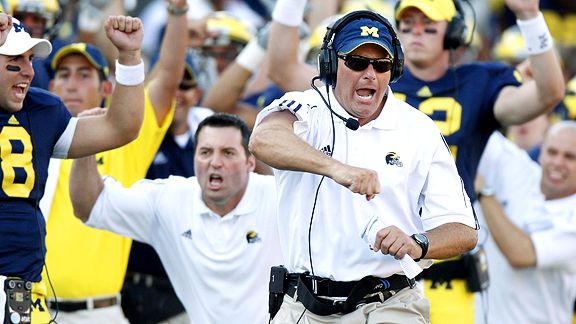
*Addendum* Rosenberg wrote the massive post-press conference story, and even when the University itself calls out the Free Press in their response, illuminating the garbage in the original Rosenberg story, not one mention of it in the recap of the press conference.
I'm attempting to look at a larger issue here: the failure of a group of (supposedly) professional journalists to put out a totally factual story, to instead try to sell a few extra newspapers.
The context here is of course, the NCAA investigation into the Michigan football program's compliance with the limits on official practice time, and issues with monitoring said practice time (i.e. quality compliance staff not doing what they are paid to do).
Sidenote: Did you know that college athletes devote a lot of time to athletics??
Related Documents: UM's formal response to the NCAA (PDFs), and the original notice of allegations.
OK. Mike Rosenberg was a good journalist before writing that above story. He attended Michigan, and wrote for The Daily's sports page while he was here. Not sure if he had some bad weed that week or if he took a conversion trip to Columbus, but he should know better. He baited two freshman football players into twisting their words around to get Rich Rodriguez in trouble, and it's no secret that Rosenberg was never a fan of the Rodriguez hire. Rosenberg inferred from Hawthorne and Stokes's comments that clearly Michigan was exceeding the number of allotted practice hours, and unnamed players backed up his assertion. We have since learned that some of those players were disgruntled Carr recruits who didn't like putting in the work, or just players who wanted to support Rodriguez and got fooled. This included Morgan Trent, Terrence Taylor, possibly Terrence Robinson, Charles Stewart, and Tony Clemons. Mark Snyder, who usually covers day-to-day Michigan football developments, got completely sucked in by the allure of a smash story, and reported information that wasn't verified.
All the quoted players also made it appear as if everything they were doing as part of offseason activities, and workout regimens, was mandatory. Again, if you're a journalist with half a damn brain, doesn't something go off inside said brain saying, "gee, I wonder if I should ask the coaches what's required of their players?"
They in turn printed information about: how Sundays were brutal on players, how they had to do every workout activity, and skip class if needed, and all this added up to approximately eight hours each day during the week and after games, and nine hours every Sunday. Even I know that if you coerce a player into telling you what you want to hear, that doesn't make it true.
Yes, Michigan did admit to violations on this issue, simply because the NCAA did find that two quality control staffers weren't following the rules -- but not nearly as damning as Snyder and Rosenberg made it out to be. They got their information from dubious sources, and used what was a detailed investigative piece to take a shot at the school and at the coaches. For what reasons, I don't know, but they succeeded in making Michigan out to be the villain of college football, and an exception to the rule that all the giants of the sport have ever done anything out of line.
To base a story on a simple lead of 'voluntary workouts exceeding NCAA rules' is bad journalism, and The Free Press, and Mike Rosenberg and Mark Snyder and their editors, will all eat their hats, and their own shit, when they realize every school in the country likely treats voluntary workouts as being 'voluntarily mandatory.'
That USA Today story linked above should be put on Rosenberg's and Snyder's pillows, because they were clearly blinded by their pursuit of a bogus story. Michigan or any other school would never force players to break rules, but by the example of a school in East Lansing, clearly Michigan is the devil.
And I'm the unemployed journalist.
19 April 2010
Status Report

Spring football scrimmages are always perplexing to me. It is hard to tell whether all starting players on the offense are playing against all potential starters on defense. The situation in Ann Arbor on Saturday seemed to be a mixed bag. Denard Robinson was sent out with 1st team offense against a mix of backup DB's and the starting linebacker corps., and Tate Forcier was sent out with a ton of Freshman against equally mixed defense.

No one got injured, and I imagine the coaches didn't pull all the fancy plays out of the book. It's difficult for me to place where this Michigan team stands in comparison to last year. I definitely think the team *will* be better. How much better is dependent on how Rodriguez uses the weapons he has, because the team has all the pieces to be good.
Random Thoughts
QBs: If Tate ever gets pulled in a game because of poor play, the opposing team better watch out. Denard looked scary good, and was zinging passes all around the field, and cut upfield if everyone was blanketed. I doubt Robinson would get the starting job, but stranger things have happened. Devin Gardner on the other hand, better not ever see the field. He walked out amidst a rousing cheer, and fumbled his first snap, and threw an interception a few passes later.

RBs: Vincent Smith didn't play, and Mike Shaw and Fitz Toussant didn't really do much. Mike Cox ran in a TD with some nifty moves, so perhaps he will step up in games.
WR: Roy Roundtree stole the show again this year, and he's got the most ability. Jeremy Gallon made some awesome leaps to grab high balls, and Daryl Stonum was a non-factor. The beauty of this group is that there are so many of them, after being thin two years ago, that Rodriguez won't have any problem putting in the right guy for specific plays.
Defense: Hard to judge. DBs looked better, and Obi Ezeh was all over the field. Don't really know much beyond that.
Rodriguez has got to get all the pieces locked in, because this is do or die time...and anything less than six bowl-eligibility-making wins is going to draw the wrath of the fanbase.
18 April 2010
Preaching the ET Gospel
At one point during the evening, an elderly man said Thomas Friedman reminded him of an evangelist. In a good way, I hope, because last night at Lake Michigan College, Friedman tried to convince 3,000 people to testify and convert to his Green Religion.

I had the good fortune of hearing Friedman speak once before, at Eastern Michigan University, when his latest book had just been published. Listening to him is an experience, because it's not like listening to most journalists or even heads of state. It's a lot like listening to a distinguished professor give a semester-ending lecture, but he has such worldly knowledge that one is compelled to hang on every point.
"In 2007 and 2008, mother nature and the market hit a wall," said Friedman bluntly.
One has to understand that the reason Friedman gives this speech everywhere he goes, is because he's trying to help reverse the vanished legacy of the greatest generation, a legacy left for us, but we in turn "ate through the greatest generation like hungry locusts," said Friedman.
Much of his material can be found right in the pages of his book, but there are some worth being pulled onto this page.

The overall metaphor for what Friedman envisions is twofold. (1) picture of a billboard he showed onscreen. It was a car advertisement in South Africa, claiming "German engineering. Swiss Parts. American Nothing." (2) The Doha & Dalian condition -- meaning there are little Manhattans sprouting up all over the globe, and two of those are in Doha, Qatar, and Dalian, China.
All these forces and variables are clashing together, toward a situation where energy consumption, population growth, and climate, converge and produce a world that is far different than our current world.
Friedman is opportunistic. That is, if America seizes all these "megaproblems" as said opportunity, to find a way to produce clean electrons, at scale, and transfer from the Information Technology Revolution to the Energy Technology Era. Simple, right?
The large problem thus far of American efforts to get in on this trend, is this. "If it's a revolution, why is no one hurt?" Friedman asked rhetorically. I take that to mean our leaders have not been aggressive enough, and if we as a country truly wanted to end addiction to oil and bad energy habits, why are those bad habits allowed to still operate?
Friedman wants palpable change, not just 192 signatories on some vague legislation that puts loose regulations on carbon emissions. The secret lies within costs and scale. Figuring a durable price on carbon in turn leads to scale, and once scale is achieved, the revolution begins. By that he means the market begins to respond to the scale, and things can be produced for the masses. Its what Friedman calls being "Democratically Chinese."

I had the good fortune of hearing Friedman speak once before, at Eastern Michigan University, when his latest book had just been published. Listening to him is an experience, because it's not like listening to most journalists or even heads of state. It's a lot like listening to a distinguished professor give a semester-ending lecture, but he has such worldly knowledge that one is compelled to hang on every point.
"In 2007 and 2008, mother nature and the market hit a wall," said Friedman bluntly.
One has to understand that the reason Friedman gives this speech everywhere he goes, is because he's trying to help reverse the vanished legacy of the greatest generation, a legacy left for us, but we in turn "ate through the greatest generation like hungry locusts," said Friedman.
Much of his material can be found right in the pages of his book, but there are some worth being pulled onto this page.

The overall metaphor for what Friedman envisions is twofold. (1) picture of a billboard he showed onscreen. It was a car advertisement in South Africa, claiming "German engineering. Swiss Parts. American Nothing." (2) The Doha & Dalian condition -- meaning there are little Manhattans sprouting up all over the globe, and two of those are in Doha, Qatar, and Dalian, China.
All these forces and variables are clashing together, toward a situation where energy consumption, population growth, and climate, converge and produce a world that is far different than our current world.
Friedman is opportunistic. That is, if America seizes all these "megaproblems" as said opportunity, to find a way to produce clean electrons, at scale, and transfer from the Information Technology Revolution to the Energy Technology Era. Simple, right?
The large problem thus far of American efforts to get in on this trend, is this. "If it's a revolution, why is no one hurt?" Friedman asked rhetorically. I take that to mean our leaders have not been aggressive enough, and if we as a country truly wanted to end addiction to oil and bad energy habits, why are those bad habits allowed to still operate?
Friedman wants palpable change, not just 192 signatories on some vague legislation that puts loose regulations on carbon emissions. The secret lies within costs and scale. Figuring a durable price on carbon in turn leads to scale, and once scale is achieved, the revolution begins. By that he means the market begins to respond to the scale, and things can be produced for the masses. Its what Friedman calls being "Democratically Chinese."
22 March 2010
The Aftermath

It took about twelve hours for those who are vehemently opposed to health care legislation to start their push to kill it. Before it has even been signed no less.
The vote last night has caused me to consult some sources, and I've found some important spots for where to read all the pertinent legislation, and where things stand.
NYT has a comprehensive page that is tracking the legislation.
They also have a map of the official Roll Call record.
And a page that shows what has been changed in the new bill.
Go here for the text of the original Senate Bill, H.R. 3590.
Go here for H.R. 4870, the Reconciliation Bill.
Whew that's a lot of information.
Once the bill is signed, there are twelve states that are ready to pounce on this thing, and take it to court. The Florida and South Carolina Attorney's Generals offices have filed a suit in U.S. District Court to challenge not only the constitutionality of the legislation, but also to force it to be thrown out of Congress, and thus repealed. Which erases all the work the President did the past few weeks.
Even Michigan is pissed off, because our Attorneys General Mike Cox has joined a similar suit, that would exempt the state of Michigan from this new federal legislation, effectively denying all its citizens the chance to buy healthcare when they need it. Thankfully, he needs 340,000 signatories on a petition to put it on the ballot in November, according to Michigan Radio this afternoon.
The other suit is in reference to the Tenth Amendment of the Constitution. South Carolina's Attorneys General was on MSNBC explaining his reasons. These reasons included, "It's the right thing to do," and, something to the effect of "I don't want government takeover of healthcare."
The Tenth Amendment to the Constitution reads:
The powers not delegated to the United States by the Constitution, nor prohibited by it to the States, are reserved to the States respectively, or to the people.
I think the grounds for the suit is that since national health care was never put into the Constitution, it is the right of each state in the union to devise their own. And, since there is no prohibition of States doing so, then it is doubly their right to do it themselves. The plaintiffs argue that this legislation infringes on States' rights, and cannot be implemented.
It seems to me that the point of contention within the actual legislation is the "individual mandate" and its tax penalty, and the supposed requirement of states to spend more on healthcare services.
The mandate doesn't take effect until after 2014, but basically the penalty is a flat rate of 1% of personal income, or, about $95 a year for most people...however it does jump to about $395 per person one year later, and as much as $2,085 per family after 2016. I'm guessing they came up with this mandate to help defray the cost of some of the other policies like Medicare expansion and creating the insurance exchanges. How is this any more outrageous than any existing tax brackets that we Americans currently adhere to?
Second, the requirement that states MUST spend more on healthcare services. It seems the thinking here among the plaintiffs is that most states couldn't possibly afford to increase Medicaid program spendings, with tight budgets and all. Perhaps that is why the government is essentially paying for states to pay for it? The bill simply requires all states, by 2013, to pay primary care doctors the equivalent of what Medicaid already pays them (possibly to eliminate the more expensive forms of Medicare that is an unnecessary cost?)
At this point and time, I don't see how that in particular is an overreach of the federal government's power. I think these states are forgetting that part of the bill institutes policies for allowing STATES to create their own insurance exchanges, so that people without employer-subsidized healthcare can get it. And if that doesn't work, the bill creates TWO separate insurance offerings, overseen by the exact same office that does the Federal employee health care exchange, The Office of Personnel Management. One is even required to be a nonprofit agency, essentially creating the exact same thing federal employees get, but separate, with individually calculated premiums. It's just like Obama has said: if the health insurance that he and members of Congress get is good enough for them, it should be good enough for the rest of America. It's the "public option" but in a much more competition-oriented form, and if the States bitch about creating statewide insurance exchange or joining a regional one, then don't pay for it! Your people have the option of going to this insurance market, you fools!
09 March 2010
Christianity & The Founders
*Update: The Texas Board of Education caved, and curriculum will now be dictated by a Christian-centric view.
*EDIT: I realize Protestantism is a denomination of the Christian faith, but for these purposes, when the claim is that America was based around Christian principles, that is a distortion. I contend that the Republican principles from which America was born are in no way directly taken from the Bible.

Far be it from me to criticize religion, organized or otherwise, but, the rate at which modern Christianity seeps into the public domain, as well as our politics, is alarming on an historical level.
How Christian Were The Founders?
Of course Texas is at the heart of the argument...but the larger issue is the conception among evangelical Christians that somehow our founding fathers would fully endorse the pattern of letting religion take over things like public school and science. It is no irony either that the first state to enact statewide curriculum guides in 1998 is the same state aiming to totally alter how their children learn in grades K-12.
I can see it now: thousands of kids taught to believe that The Bill of Rights answers to The New Testament, humans came from God's tears, and liberalism is the work of Satan.
Is that where we want our educational system in America to go? I sure don't. I seem to remember something in The Constitution protecting the state from the influence of religion, and vice versa, in the interest of creating the most free society on the planet. There was one society that tried to govern in the name of God, and England ended up losing its position as the most powerful nation on Earth...because it's most important subjects separated from the crown, and founded a society based on ideas that come from the mind and not God. Even the fucking Arabs came up with mathematics and laws and architecture and philosophy, while maintaining a safe distance from Allah in matters of state.
It seems a fundamental contradiction of ideas when people in the 21st Century are attempting to overpower all other religions in America in the hopes of returning "Gods work" to its true heirs, when in 1776 men of all faiths protected the persecution of Quakers, Baptists, Christians, Protestants, and you-name-its. Thomas Jefferson for one was a staunch defender of the First Amendment, fully resistant to the idea of a president taking involvement with religion.
I personally believe the founders, since their ancestors came from a predominantly Protestant country, are Protestant first and Christian second. There's an academic quoted in that article who says "98 percent of Americans of European descent identified with Protestantism."
I once saw a documentary film called "Constantine's Sword," in which the author of the like-titled book, James Carroll, travels old Christendom seeking an answer as to why the religion he once knew from the clergy has become so different. Perhaps its because people like the Air Force or Gerry Falwell or Pat Robertson act like prophets when all they're really doing is preaching radical Christianity the same way a Muslim cleric preaches radical Islam. I say that because that has happened: the Air Force has had a problem requiring cadets at its school in Colorado Springs to attend religious services, even if they do not belong to the Christian faith. All done in the interest of converting cadets to this altered Christianity
Some think John Winthrop was envisioning a nation that advanced God's work through Christianity. Indeed, the United States of America was to be a "City on a Hill," as a beacon to all free men, but, was it founded on a bedrock of Christian teachings? The First Amendment would indicate that it was not. The Constitution's inherent purpose is to defend against a national denomination, no?
A pretty fascinating debate about some pretty large concepts. If there's one thing that makes me sad, though, it's that conservatives in Texas want Christianity incorporated into teachings of American History, so as to distort all subsequent events since America's founding to reflect a particular view. It's alarming to think what that leads to.
*EDIT: I realize Protestantism is a denomination of the Christian faith, but for these purposes, when the claim is that America was based around Christian principles, that is a distortion. I contend that the Republican principles from which America was born are in no way directly taken from the Bible.
Far be it from me to criticize religion, organized or otherwise, but, the rate at which modern Christianity seeps into the public domain, as well as our politics, is alarming on an historical level.
How Christian Were The Founders?
Of course Texas is at the heart of the argument...but the larger issue is the conception among evangelical Christians that somehow our founding fathers would fully endorse the pattern of letting religion take over things like public school and science. It is no irony either that the first state to enact statewide curriculum guides in 1998 is the same state aiming to totally alter how their children learn in grades K-12.
I can see it now: thousands of kids taught to believe that The Bill of Rights answers to The New Testament, humans came from God's tears, and liberalism is the work of Satan.
Is that where we want our educational system in America to go? I sure don't. I seem to remember something in The Constitution protecting the state from the influence of religion, and vice versa, in the interest of creating the most free society on the planet. There was one society that tried to govern in the name of God, and England ended up losing its position as the most powerful nation on Earth...because it's most important subjects separated from the crown, and founded a society based on ideas that come from the mind and not God. Even the fucking Arabs came up with mathematics and laws and architecture and philosophy, while maintaining a safe distance from Allah in matters of state.
It seems a fundamental contradiction of ideas when people in the 21st Century are attempting to overpower all other religions in America in the hopes of returning "Gods work" to its true heirs, when in 1776 men of all faiths protected the persecution of Quakers, Baptists, Christians, Protestants, and you-name-its. Thomas Jefferson for one was a staunch defender of the First Amendment, fully resistant to the idea of a president taking involvement with religion.
I personally believe the founders, since their ancestors came from a predominantly Protestant country, are Protestant first and Christian second. There's an academic quoted in that article who says "98 percent of Americans of European descent identified with Protestantism."
I once saw a documentary film called "Constantine's Sword," in which the author of the like-titled book, James Carroll, travels old Christendom seeking an answer as to why the religion he once knew from the clergy has become so different. Perhaps its because people like the Air Force or Gerry Falwell or Pat Robertson act like prophets when all they're really doing is preaching radical Christianity the same way a Muslim cleric preaches radical Islam. I say that because that has happened: the Air Force has had a problem requiring cadets at its school in Colorado Springs to attend religious services, even if they do not belong to the Christian faith. All done in the interest of converting cadets to this altered Christianity
Some think John Winthrop was envisioning a nation that advanced God's work through Christianity. Indeed, the United States of America was to be a "City on a Hill," as a beacon to all free men, but, was it founded on a bedrock of Christian teachings? The First Amendment would indicate that it was not. The Constitution's inherent purpose is to defend against a national denomination, no?
A pretty fascinating debate about some pretty large concepts. If there's one thing that makes me sad, though, it's that conservatives in Texas want Christianity incorporated into teachings of American History, so as to distort all subsequent events since America's founding to reflect a particular view. It's alarming to think what that leads to.
25 February 2010
Set the Record Straight

The most overused line in the health care fight has been, "something has to be done". Well, today was a step toward something. The White House is trying to get everyone to put their grievances out on the table.
As I watch this health care summit unfold on live television, I don't doubt that *something* will get accomplished. Either the Democrats will muscle a terrible bill through the Congress, by way of reconciliation (not out of the question at this point), or, our Congress will grow some balls and make a compromise. I don't care which path they choose, but get your heads out of your asses and realize that there is a world outside of your respective chambers. This was a remarkable thing, for a President to convince Congressional leadership to let what would otherwise have been a closed-door meeting, be aired on national television (of course CNN and MSNBC resorted to talking over them half the time, so I watched it on the internet).
It boils down to something Senator Chris Dodd said today, saying in effect, "There are enormous costs associated with our being here (referring to people losing insurance or their lives each day while their government sits on its hands). And Keith Olbermann said last night, it amounts to, "an American cry for help."
A lot of issues came up during the discussion, and thankfully, there was little mention of socialist plots or death panels. The Republicans take issue with the cost and the access to coverage, and the Democrats take issue with the quality of coverage and how it's handed out.
The White House Health Care reform site lays out the need for reform, and of course the President's plan is a slightly less costly version of the House bill.
All of these politicians hammer on the point that the American health care system is the best in the world...but why do only federal employees and the wealthy have access to its full spectrum of benefits? That's wrong.
I discovered some alarming things over the course of the day, involving horror stories of people not being able to pay for coverage. Either people's coverage is abruptly cancelled, or Medicare stops covering seniors' care, or people are denied coverage in the first place.
No one knows this about me save for a few select individuals, but, without health care, neither of my parents would likely be alive -- or else they would be in danger of succumbing to some terrible things. My mother has Blue Cross Blue Shield through her employer, and without that coverage, my life would be an entirely different set of circumstances right now. My Dad had an early prostate cancer diagnosis, and it was treated immediately (a few years ago), and all the costs were paid for. Upwards of $50,000 when it was all finished, with surgery costs, hospital stay, and the tests before and after the surgery he had.
The rest of those alarming things involve insurance companies denying coverage on the grounds of preexisting conditions. Among things that people have been denied coverage from include things that my family has, either in family history, or currently. Prostate cancer, Uteran cancer, Acne, pregnancy, having been treated for depression, and lung/heart disease.
I once had a mysterious low white blood cell count problem a few years back, and that would likely crop up in a reason to deny me coverage, if something is not done with this reform. I'm taking medication for depression, and have acne breakouts -- all things that can deny coverage in some states. Presently, if I got sick, and the right insurance company looked at my medical history and saw that I am seeing a psychologist, they would deny me coverage on the grounds of me having been treated within the last six months by said psychologist. All those are "preexisting conditions" to some companies.
My mother now has uteran cancer, and is being treated. A total hysterectomy in September removed the immediate threat, but her full program is not over. The University of Michigan health system diagnosed a middle stage aggressive cancer that would have killed her had it not been found. What would have happened if her insurance company declared that a preexisting condition? I've looked at her medical bills, and it's enough to put us in the poor house. Chemo visits are thousands of dollars, and one shot she gets is about a thousand dollars each time. My sister-in-law is pregnant, making my brother -- who is covered under *her* insurance, and "expectant father." That is grounds for denial in some states.
And lastly, my grandfather. He's 91 years old, and he almost died last week. His heart nearly stopped working, but quick action on the part of whatever doctor he saw saved him. But then they found other infections, and lung cancer. He's on Medicare, and he was in the emergency room, followed by the regular hospital, for one full week. Why can't people who are half his age have access to Medicare, or an insurance exchange, or something modeled on the federal employees' program? My grandfather would have died on a hospital bed instead of being able to get Hospice care to help him go peacefully when the time comes, if he didn't have Medicare, and because that coverage didn't decide to classify that lung cancer as a preexisting condition, since the man smoked socially for sixty years. If my family is fortunate enough to have survived all these scares, and if I'm fortunate enough to avoid a scare with my well-being, people that are way worse off than us should be as fortunate. It's just wrong not to try and have that fortune be the norm.
If the Congressional Budget Office says this plan is budget-neutral, that should be good enough. I don't want to hear another year of people whining about some socialist takeover of the health care system (Eric Cantor), or that it federally-funds abortions (John Boehner), or that it removes any choice people have to get the best care for themselves (John Kyl), or that it costs too much (Mitch McConnell). It's all bullshit, and they know it.
Politics shouldn't decide whether someone gets treated for an illness. The people who are lying on a hospital bed dying because they can't pay to get better should decide that. This is about "life panels" as Olbermann put it, because this is a bill to improve lives, not take them away. Starting over is the real death panel.
24 February 2010
I Attempt to Review a Video Game

Mass Effect 2 released last month, and its Metascore is sitting at 96/100. No surprise, since we fans have waited three whole years for the middle child of the sci-fi sequel.
There's an inherent paradox within game reviews: people rave about wonderful games, but ignore the larger flaws, in the interest of keeping alive the pandering to the masses to give a game a positive mark. See: Bayonetta, Uncharted 2: Drake's Fortune, Gears of War 2, Halo: ODST -- you get the idea. Games earn critical acclaim almost out of a compulsion of said industry to bow down to the hype being manufactured by the games' publishers.
That being said, Mass Effect 2 avoids the "quick fix" pitfall, and presents a complex, and complete, epoch within a larger narrative. Don't let anyone tell you that it drags on and on, as Seth Schiesel of The New York Times said in his review...the game engages you in such a way to where you feel a deep connection to the characters. I wanted to help them, and see to it that they survived the course of the game. Only Bioware can make a game that has characters that are more real and more compelling than most people we encounter in our daily lives. They have stories to tell, knowledge to share, and most important of all, bloodlust to exercise.
Bioware aimed for a more real-time experience, and they got it. Pauses in the combat are gone, everything can be hotkeyed, and the framerate never -- I said never -- drops. Voice-acting is exceptional, with some pretty well-known people chiming in with small roles along the journey, as well as the big gun, Martin Sheen, anchoring the main crux of the story. Unlike the first game, the story is a little murkier, and, the decisions are equally as murky. When you think you want to do something heroic, you end up doing something cold-blooded. The story even has a fair amount of surprise, and major plot developments are reserved for when you aren't expecting it. Very rarely do I play a game where by the end, I'm actually rooting for everything to turn out OK.
As is to be expected with such a huge (read: ambitious) game, there are slight flaws. A few graphical glitches here and there, but nothing that will break the game. During my playthrough, the audio cut out a few times during some dialogue scenes, which was a nuisance, because if there aren't subtitles, one may miss critical information. Sometimes the combat didn't go as expected, and I was left scrambling around not knowing what to do, or, I would unknowingly commit some egregious error and would be forced to reload to an earlier point, or hope that an autosave kicked in right before that point. Planet scanning is somewhat cool, but can be annoying if one is forced to do a lot of it in one sitting. Here's hoping DLC comes out of all these planets that aren't able to be explored yet.
My personal favorite from the game is being able to choose research upgrades on the Normandy's computer. People complained that the role-playing element had been eliminated, but, it's right here! Just because there's no more irritating inventory system or the character customization has been altered doesn't mean there isn't a way to choose how to play the game. It'd be nice if there were more weapons, yes, but to remove the unnecessary complexity of managing everything in the game is genius. The character classes function much better without having to spend time tweaking how it behaves. There's a set number of abilities, and choose carefully how the level points are spent, and it's a piece of cake after that.
If Bioware's goal was to outdo every single facet of the first game, mission accomplished.
Bioware aimed for a more real-time experience, and they got it. Pauses in the combat are gone, everything can be hotkeyed, and the framerate never -- I said never -- drops. Voice-acting is exceptional, with some pretty well-known people chiming in with small roles along the journey, as well as the big gun, Martin Sheen, anchoring the main crux of the story. Unlike the first game, the story is a little murkier, and, the decisions are equally as murky. When you think you want to do something heroic, you end up doing something cold-blooded. The story even has a fair amount of surprise, and major plot developments are reserved for when you aren't expecting it. Very rarely do I play a game where by the end, I'm actually rooting for everything to turn out OK.
As is to be expected with such a huge (read: ambitious) game, there are slight flaws. A few graphical glitches here and there, but nothing that will break the game. During my playthrough, the audio cut out a few times during some dialogue scenes, which was a nuisance, because if there aren't subtitles, one may miss critical information. Sometimes the combat didn't go as expected, and I was left scrambling around not knowing what to do, or, I would unknowingly commit some egregious error and would be forced to reload to an earlier point, or hope that an autosave kicked in right before that point. Planet scanning is somewhat cool, but can be annoying if one is forced to do a lot of it in one sitting. Here's hoping DLC comes out of all these planets that aren't able to be explored yet.
My personal favorite from the game is being able to choose research upgrades on the Normandy's computer. People complained that the role-playing element had been eliminated, but, it's right here! Just because there's no more irritating inventory system or the character customization has been altered doesn't mean there isn't a way to choose how to play the game. It'd be nice if there were more weapons, yes, but to remove the unnecessary complexity of managing everything in the game is genius. The character classes function much better without having to spend time tweaking how it behaves. There's a set number of abilities, and choose carefully how the level points are spent, and it's a piece of cake after that.
If Bioware's goal was to outdo every single facet of the first game, mission accomplished.
15 December 2009
Participant Democracy

I initially laughed at the idea in my email, but then I took it seriously. For the first time ever, I wrote a letter to my Senators, at the request of Organizing for America (formerly Obama for America), in the form of a holiday greeting card.
Dear Senators -
As you sit on the plane back to Michigan, and reflect on the (likely) failure of the health care reform, because you let Joe Lieberman and a small group of Republicans prove your incompetence, take some time to wonder how many families might spend Christmas without a loved one or someone they care about, because they were tossed to the curb the minute the vote (likely) failed.
It may seem insignificant to persons with government health insurance, but I won't forget that you didn't help close the deal the next time it's time to vote in an election. I could be wrong, and the bill will make it to President Obama's desk before the holiday, but it sticks in my mind more when it is this close, and politics prevailed over moral impetus.
It will be enlightening when in another six months, I will turn 24 years old, and have no health care coverage. Thanks, as always, for proving my painfully accurate distrust in the ability of government to actually do anything of any sort.
I'm so thankful this holiday season for the stunning incompetence my government is putting on display. I'm also SO glad that the failure weighing on your shoulders hasn't gotten heavy enough to force your hand into doing something about it, and if I didn't know better, I'd say the motivation was never really there in the first place. If it was, I would have a job, health care, and a restored faith in the America that now only exists in the history book lying on my table.
Remember Remember, the 25th of December, the day Congress ruined Christmas.
Happy Holidays, Failures!
25 October 2009
An Unpublished Work
It looks like this will never be published on UWire.com, so I'll put it on here.
====================
Piling Up the (Campus) Pork
By Kevin Bunkley
Pork has a special place in the backrooms of Washington, D.C. -- and it isn't at the front of the buffet table. It finds its way into the back pockets of nearly every politician on Capitol Hill, and now it's coming to your dormitory. Rep. John Murtha (R-PA), who is notorious for getting pork projects for his home district for defense contractors, has now managed to bring some pork to a college campus -- his alma mater, Indiana University of Pennsylvania. The Washington Post reported on a $53 million earmarked project to build a new facility to house the Murtha Institute, a group that has no mandate whatsoever for what it should use this money for.
State Universities, places that one would think are above shady political practices, are starting to get thousands of pork projects appropriated to them for the strangest of projects. Higher education has no room for federal earmarks that do nothing -- it only makes the best secondary education system in the world look as corrupt and inept as the politicians who give them the money. University Boards of Regents and Presidents are above this, and should not let Washington politics get in the way of following their own ethics. College campuses get federal funding -- our tax dollars -- to give an education, not give a few close friends of a Senator or Congressman some new digs to push paper around in.
Earmarks are not inherently bad in theory, because there have been some useful earmarks approved by Congress. The University of Michigan received millions for a new children's hospital, energy research, and cancer research. To end those would of course be foolish. It's getting easier and easier, however, for members of Congress to drum up support for the more silly of projects among their constituents because it is money for their district, and that usually means jobs. Pork projects, on the other hand, have no public benefit, and for one thing, the categorization of these grants should be designated as such. Voters may not be so keen on giving a university a million dollars to study textiles when there is no direct university involvement in such an industry.
The types of projects that are penetrating college campuses range from the stupid ($800,000 for oyster rehabilitation in Alabama), to strange ($196,000 for reducing pig odors and waste), and to the self-promoting (Sen Charles D. Rangel (D-NY) got funding for a Public Service center named after himself). And there are thousands more just like those. These are attached to the useful higher education funding bills, and almost always pass because, who wants to be scrutinized for voting against funding such a thing as a college? Certainly not an elected official.
The Chronicle for Higher Education's 2008 report on higher education earmarks says that it was at its highest total ever, at $2.3 billion. In 1990 it was a mere $270 million. It can only go up without any oversight or control. Congress must take a hard look at what's being lobbied for, and prioritize according to merit, not personal influence of high-ranking committee chairs or even alumni. During the 2008 campaign, McCain, Obama, and Clinton wanted a moratorium on earmark legislation, but of course a problem presented itself: the vote was thirty-one shy of a majority, so the legislation to end stupid legislation died on the Senate floor. Fix it by forcing Senators and members of Congress to add any and all earmarks they voted for, in addition to ones they introduced, to their public disclosures of all financial information. It would certainly give me pause if I learned that my Congressman had pushed through $80 million in projects to a university in my state, as Sen. Thad Cochran of Mississippi did for his home state. Why are our elected officials given a pass for something like that just because it's "helping" higher education in their home state?
Universities are as much to blame as the Congressman and Senators who get the earmarks. Most major universities have lobbying offices in Washington, D.C., off Capitol Hill, with the explicit purpose of getting this money. Some use it to get meaningful projects, like medical research or automobile research, or IT development, and others, in Indiana-Penn's case, use it to create shell organizations with no real benefit to their campus community or the country. A true crackdown on abuse of lobbying influence is simply yanking federal funding from universities that are building more "Murtha Institutes." A university has every right to lobby the federal government for money or help on issues, but isn't it a little dishonest to use that influence to directly lobby a member of Congress, specifically because they don't have to submit their research proposals to third-party NGOs that present them to review panels? Such a glaring loophole is a direct result of to much power given to a Senator or Congressman. When a powerful member like Murtha or Rangel proposes such a wasteful use of money, his committee must have the sense to vote to strip him of his chairmanship.
If Sen. Ted Stevens (R-AL) can get $986,000 for berry research at The University of Alaska-Fairbanks, then there are some serious loopholes in the way our colleges and universities are funded. Someone like Senator McCain could put some real pressure on all his friends if he re-introduced that bill for a moratorium on earmarks to universities with the stipulation that those who do not vote for it face having their earmark voting record disclosed to the public. It's political blackmail, but it's no different than others blackmailing voters into supporting such wastes of money by advertising that it's good for higher education. America prides itself on having the finest secondary education system in the world, and that image is disappearing faster than the pig stench in Iowa that got more money than some whole schools did.
Universities and our government are equally guilty, but universities in particular can take the high ground and eliminate the middleman. Carefully read the legislation, and refuse to lobby for anything with pork attached. And when the request for funding dies in the House or Senate, the universities are exempt from scrutiny and blame gets put squarely on the politician for letting a higher education bill fail because it didn't benefit them in any way. The loophole of no peer review for bills brought in by specific members of Congress has to be closed, for the sake of preserving what earmarks are for: us. Universities wouldn't be good at anything without them, but it's quickly destroying the image of a university as this infallible public institution, and lumping it exactly where it shouldn't be: in the same boat as our Congress. The merit of an American college degree will soon be lower than their approval ratings should this problem go unattended.
====================
Piling Up the (Campus) Pork
By Kevin Bunkley
Pork has a special place in the backrooms of Washington, D.C. -- and it isn't at the front of the buffet table. It finds its way into the back pockets of nearly every politician on Capitol Hill, and now it's coming to your dormitory. Rep. John Murtha (R-PA), who is notorious for getting pork projects for his home district for defense contractors, has now managed to bring some pork to a college campus -- his alma mater, Indiana University of Pennsylvania. The Washington Post reported on a $53 million earmarked project to build a new facility to house the Murtha Institute, a group that has no mandate whatsoever for what it should use this money for.
State Universities, places that one would think are above shady political practices, are starting to get thousands of pork projects appropriated to them for the strangest of projects. Higher education has no room for federal earmarks that do nothing -- it only makes the best secondary education system in the world look as corrupt and inept as the politicians who give them the money. University Boards of Regents and Presidents are above this, and should not let Washington politics get in the way of following their own ethics. College campuses get federal funding -- our tax dollars -- to give an education, not give a few close friends of a Senator or Congressman some new digs to push paper around in.
Earmarks are not inherently bad in theory, because there have been some useful earmarks approved by Congress. The University of Michigan received millions for a new children's hospital, energy research, and cancer research. To end those would of course be foolish. It's getting easier and easier, however, for members of Congress to drum up support for the more silly of projects among their constituents because it is money for their district, and that usually means jobs. Pork projects, on the other hand, have no public benefit, and for one thing, the categorization of these grants should be designated as such. Voters may not be so keen on giving a university a million dollars to study textiles when there is no direct university involvement in such an industry.
The types of projects that are penetrating college campuses range from the stupid ($800,000 for oyster rehabilitation in Alabama), to strange ($196,000 for reducing pig odors and waste), and to the self-promoting (Sen Charles D. Rangel (D-NY) got funding for a Public Service center named after himself). And there are thousands more just like those. These are attached to the useful higher education funding bills, and almost always pass because, who wants to be scrutinized for voting against funding such a thing as a college? Certainly not an elected official.
The Chronicle for Higher Education's 2008 report on higher education earmarks says that it was at its highest total ever, at $2.3 billion. In 1990 it was a mere $270 million. It can only go up without any oversight or control. Congress must take a hard look at what's being lobbied for, and prioritize according to merit, not personal influence of high-ranking committee chairs or even alumni. During the 2008 campaign, McCain, Obama, and Clinton wanted a moratorium on earmark legislation, but of course a problem presented itself: the vote was thirty-one shy of a majority, so the legislation to end stupid legislation died on the Senate floor. Fix it by forcing Senators and members of Congress to add any and all earmarks they voted for, in addition to ones they introduced, to their public disclosures of all financial information. It would certainly give me pause if I learned that my Congressman had pushed through $80 million in projects to a university in my state, as Sen. Thad Cochran of Mississippi did for his home state. Why are our elected officials given a pass for something like that just because it's "helping" higher education in their home state?
Universities are as much to blame as the Congressman and Senators who get the earmarks. Most major universities have lobbying offices in Washington, D.C., off Capitol Hill, with the explicit purpose of getting this money. Some use it to get meaningful projects, like medical research or automobile research, or IT development, and others, in Indiana-Penn's case, use it to create shell organizations with no real benefit to their campus community or the country. A true crackdown on abuse of lobbying influence is simply yanking federal funding from universities that are building more "Murtha Institutes." A university has every right to lobby the federal government for money or help on issues, but isn't it a little dishonest to use that influence to directly lobby a member of Congress, specifically because they don't have to submit their research proposals to third-party NGOs that present them to review panels? Such a glaring loophole is a direct result of to much power given to a Senator or Congressman. When a powerful member like Murtha or Rangel proposes such a wasteful use of money, his committee must have the sense to vote to strip him of his chairmanship.
If Sen. Ted Stevens (R-AL) can get $986,000 for berry research at The University of Alaska-Fairbanks, then there are some serious loopholes in the way our colleges and universities are funded. Someone like Senator McCain could put some real pressure on all his friends if he re-introduced that bill for a moratorium on earmarks to universities with the stipulation that those who do not vote for it face having their earmark voting record disclosed to the public. It's political blackmail, but it's no different than others blackmailing voters into supporting such wastes of money by advertising that it's good for higher education. America prides itself on having the finest secondary education system in the world, and that image is disappearing faster than the pig stench in Iowa that got more money than some whole schools did.
Universities and our government are equally guilty, but universities in particular can take the high ground and eliminate the middleman. Carefully read the legislation, and refuse to lobby for anything with pork attached. And when the request for funding dies in the House or Senate, the universities are exempt from scrutiny and blame gets put squarely on the politician for letting a higher education bill fail because it didn't benefit them in any way. The loophole of no peer review for bills brought in by specific members of Congress has to be closed, for the sake of preserving what earmarks are for: us. Universities wouldn't be good at anything without them, but it's quickly destroying the image of a university as this infallible public institution, and lumping it exactly where it shouldn't be: in the same boat as our Congress. The merit of an American college degree will soon be lower than their approval ratings should this problem go unattended.
19 October 2009
Nobody Does it Better
Came a feature story in the Washington Post on Sunday: one of those rare times when Bob Woodward does actual reporting instead of getting in everyone's back pocket to get fodder for whatever book he's writing. Thank goodness the Bush administration is no longer around, too, otherwise he would be sidetracked writing a fifth Bush expose !
Woodward and Gordon M. Goldstein have combined some interviews they did a long time ago with Robert S. McNamara, and MacGeorge Bundy, each prior to the mens' deaths. It's a detailed explanation of the internal debates over Vietnam, and it's definitely done with the present situation in Afghanistan in mind.
"The Anguish of Decision" (note that the print version of this story had a great photo of President Johnson & McNamara seated next to each other, both with expressions of total exhaustion and mental conflict on their faces.
Woodward and Gordon M. Goldstein have combined some interviews they did a long time ago with Robert S. McNamara, and MacGeorge Bundy, each prior to the mens' deaths. It's a detailed explanation of the internal debates over Vietnam, and it's definitely done with the present situation in Afghanistan in mind.
"The Anguish of Decision" (note that the print version of this story had a great photo of President Johnson & McNamara seated next to each other, both with expressions of total exhaustion and mental conflict on their faces.
13 October 2009
Obama's War

PBS just wowed me with the season premiere of "Frontline."
In the book "The Gamble," by Thomas Ricks, the final section was called "Obama's War," hinting that in his view, President Obama's national security legacy hinged not on success in Iraq but success in Afghanistan.
After watching this program just now, I couldn't agree with that sentiment more.
It focused mainly on the challenges of the new counter-insurgency strategy developed by General Petraeus, and the issues with Pakistan. They had an embedded war correspondent following a unit in the Helmund Province, one of the areas that General McChrystal would like more troops sent to to interact with the local populace and force the Taliban out of hiding.
The whole (!!) program is available online right now, and they have some other goodies on their website.
My man Steve Coll was interviewed (his blog can also be read on The New Yorker site), much to my delight, as well as top ambassadors, generals, and regional experts.
"Frontline" is one of those programs where I go, "WOW, this is on PBS!!" and it proves the worth of public broadcasting and radio, exponentially.
09 October 2009
Things That Make The World Explode
Figuratively speaking.
In under 14 hours, both the American media and the international media have exploded over President Obama's receipt of the Nobel Peace Prize.
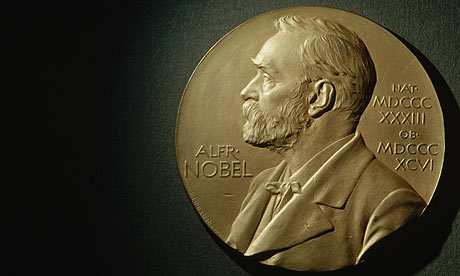
Obama, at the Rose Garden, said in essence:
In under 14 hours, both the American media and the international media have exploded over President Obama's receipt of the Nobel Peace Prize.
Obama, at the Rose Garden, said in essence:
I will accept this award as a call to action, a call for all nations and all peoples to confront the common challenges of the 21st century. These challenges won't all be met during my presidency, or even my lifetime. But I know these challenges can be met so long as it's recognized that they will not be met by one person or one nation alone.
NPR aired Rush Limbaugh's comment during their hourly news updates, in which Limbaugh said Obama's award was a bigger embarrassment than Chicago losing the Olympics bid.
But how much do we really know?
The Nobel Committee is a majority of liberal politicians, but international peace is kind of de facto liberalism to me anyways. The Norwegian government elects each member of the Nobel Committee, and, politically, it's about on par with the British Labour Party, not the American Democratic Party. If Obama were a British politician in the 1990s before Tony Blair, he never would have had a chance in hell.
Obama has lofty goals for his Presidency, and if he meets half of them, he deserved this award. The one that sticks out to me is his push for the elimination of nuclear weapons. That's on par with Woodrow Wilson's creation of the League of Nations. Times two.
This isn't about politics. It's about a vision for the world. A commentator on NPR's website said that Obama owes George Bush for this award because Bush screwed up America's image so much that it was a cakewalk for Mr. Obama to give a few speeches and suddenly be given a Nobel Prize.
Fox News, the bastion of intellect, put an op/ed on their website diminishing the Nobel Prize down to a laundry list of photo ops and speeches.
It's remarkable that Obama won for his vision for the world, and I'll be curious to see if a journalist ever gets ahold of the "portfolio" that the Committee referred to when making it's selection.
Obviously, they saw the same thing that a majority of Americans saw on November 8th.
I'm just sitting back and watching a sitting American President win one of the most prestigious things in existence for the first time in 90 years. If anything, reduce it to that, and you'll all feel better.
I wonder though, should Obama have declined the award??
No. He did the right thing in using it as an impetus to continue his work. However, it remains to be seen what he will do with the large sum of money he gets along with the award. He should donate it to one of the foundations that helps families of fallen soldiers, or something similar.
I wonder though, should Obama have declined the award??
No. He did the right thing in using it as an impetus to continue his work. However, it remains to be seen what he will do with the large sum of money he gets along with the award. He should donate it to one of the foundations that helps families of fallen soldiers, or something similar.
05 October 2009
Before I left Ann Arbor...
I wrote a little column for a tiny little publication called Consider Magazine.
It was published today, have a look. I previously posted a few drafts of this piece, but it looks fancier on the website.
http://consideronline.org/2009/10/05/has-google-become-too-big/
It was published today, have a look. I previously posted a few drafts of this piece, but it looks fancier on the website.
http://consideronline.org/2009/10/05/has-google-become-too-big/
29 September 2009
Epic Pregame Videos
This season the Michigan football games have featured a new pregame video each week, and they are actually really good. It would help if the new speaker system were installed this year, because there's spots where the audio gets really crackly and overloaded just because it's blaring out of about four speakers on top of the press box.
The videos can be viewed here at Oldhat.tv (warning: contains spoilers to old games), and give them time to buffer because there's a lot going on onscreen. Go Blue !
The videos can be viewed here at Oldhat.tv (warning: contains spoilers to old games), and give them time to buffer because there's a lot going on onscreen. Go Blue !
18 September 2009
So Long, "Star Wars"
President Obama has surprised me again, totally breaking pattern on another national security challenge that he had previously not come up with solutions for.
The President effectively erased all hope for those in Washington that wanted to see the initialization of President Bush's aim to create Ronald Reagan's dream of a missile defense network to guard against nuclear attacks aimed at the United States. Hawks lovingly referred to the proposed program as "Star Wars" in honor of President Reagan, but the technical term is the Strategic Defense Initiative (SDI).
The SDI Program's technology combines the use of satellites with x-ray lasers, aerial reconnaissance, tactical missiles, and a whole host of other toys to shoot down Inter-continental ballistic missiles (ICBMs) armed with nuclear warheads or even biological agents.
Upon first taking office, President Obama was proposing putting a missile defense shield in the areas around Poland, and the Czech Republic, nudging up dangerously close to the Russian border with Eastern Europe.
Not so, anymore, though, as President Obama yesterday gave a very encouraging speech that drew approval from Russia's biggest power-wielder. The U.S. will scrap the original plans for the missile shield and instead focus on having medium and short-range antimissiles that can reach Iran to protect Israel. The Russians would also take down a proposed defense base on their border in Kaliningrad.
To me this is a giant step forward in normal diplomatic relations with the Russian Federation. I don't doubt that if the program had continued on its original course, the United States and Russia would have been in a (Cold) War of not defense buildups but words and oneupsmanship. President Reagan always called the Soviet Union the "Evil Empire," but there's so much more information available about Russian politics during the 1980s and 1990s that it just makes them look like a nation trying to find its place in the world and to define their nation itself.
Bravo, Mr. President.
The President effectively erased all hope for those in Washington that wanted to see the initialization of President Bush's aim to create Ronald Reagan's dream of a missile defense network to guard against nuclear attacks aimed at the United States. Hawks lovingly referred to the proposed program as "Star Wars" in honor of President Reagan, but the technical term is the Strategic Defense Initiative (SDI).
The SDI Program's technology combines the use of satellites with x-ray lasers, aerial reconnaissance, tactical missiles, and a whole host of other toys to shoot down Inter-continental ballistic missiles (ICBMs) armed with nuclear warheads or even biological agents.
Upon first taking office, President Obama was proposing putting a missile defense shield in the areas around Poland, and the Czech Republic, nudging up dangerously close to the Russian border with Eastern Europe.
Not so, anymore, though, as President Obama yesterday gave a very encouraging speech that drew approval from Russia's biggest power-wielder. The U.S. will scrap the original plans for the missile shield and instead focus on having medium and short-range antimissiles that can reach Iran to protect Israel. The Russians would also take down a proposed defense base on their border in Kaliningrad.
To me this is a giant step forward in normal diplomatic relations with the Russian Federation. I don't doubt that if the program had continued on its original course, the United States and Russia would have been in a (Cold) War of not defense buildups but words and oneupsmanship. President Reagan always called the Soviet Union the "Evil Empire," but there's so much more information available about Russian politics during the 1980s and 1990s that it just makes them look like a nation trying to find its place in the world and to define their nation itself.
Bravo, Mr. President.
31 August 2009
Darth Cheney Reprise
*Updates*
24 hours later, the White House and some politicians are hitting back at Cheney.
My favorite comment comes from Chris Matthews:
"Chris Matthews, at the opening of MSNBC's Hardball, said Dick Cheney is 'attacking the Obama White House for investigating the abuse of prisoners. He is taking the unusual role of defending the CIA itself, an agency he bullied and ridiculed for eight years in his role as vice president. And is he's getting hit by John McCain, who has two advantages over Cheney. One, he knows what it means to be tortured. Two, he knows what it means to serve his country.'"
Reuters also says Obama's National Security Adviser, General Jim Jones, is trying to prove Cheney wrong. Oddly enough, General Jones wants a pullout from Afghanistan. But just because the top commander in Afghanistan didn't request more troops in his report, doesn't mean Obama isn't listening. I know for a fact that Obama holds David Petraeus in utmost regard, he's not going to cause an embarrassment.
Original Post:
Good summary of the former VP's comments:
And lastly, John McCain's comments on "Face the Nation" yesterday.
24 hours later, the White House and some politicians are hitting back at Cheney.
My favorite comment comes from Chris Matthews:
"Chris Matthews, at the opening of MSNBC's Hardball, said Dick Cheney is 'attacking the Obama White House for investigating the abuse of prisoners. He is taking the unusual role of defending the CIA itself, an agency he bullied and ridiculed for eight years in his role as vice president. And is he's getting hit by John McCain, who has two advantages over Cheney. One, he knows what it means to be tortured. Two, he knows what it means to serve his country.'"
Reuters also says Obama's National Security Adviser, General Jim Jones, is trying to prove Cheney wrong. Oddly enough, General Jones wants a pullout from Afghanistan. But just because the top commander in Afghanistan didn't request more troops in his report, doesn't mean Obama isn't listening. I know for a fact that Obama holds David Petraeus in utmost regard, he's not going to cause an embarrassment.
Original Post:
Good summary of the former VP's comments:
And lastly, John McCain's comments on "Face the Nation" yesterday.
28 August 2009
Best of Ted
In my mind the most important thing Ted Kennedy ever did was help change the voting age to 18, suddenly giving a political voice to millions of young people that previously had none.
He was liberal, yes, but he was a broker. He was the one who got people to agree on things, and now only two days after he's gone, the Senate and House have descended into chaos. Democrats are on a kick that they ought to pass health care reform as a symbol of the man. Republicans are on a moral stance that health care shouldn't be politicized (kind of hypocritical, no?). Senator Orin Hatch of Utah said it most simply on ABC News: "some are saying let's pass the bill in honor of Ted, but I'm saying, hold on a minute, he would want us to pass something that's good."
Kennedy's morals were always above the rest it seems, when he said during debate of the voting age law, "If at 18 you are old enough to be drafted to fight for your country, then you should be old enough to elect leaders that might send you to do so."
He was liberal, yes, but he was a broker. He was the one who got people to agree on things, and now only two days after he's gone, the Senate and House have descended into chaos. Democrats are on a kick that they ought to pass health care reform as a symbol of the man. Republicans are on a moral stance that health care shouldn't be politicized (kind of hypocritical, no?). Senator Orin Hatch of Utah said it most simply on ABC News: "some are saying let's pass the bill in honor of Ted, but I'm saying, hold on a minute, he would want us to pass something that's good."
Kennedy's morals were always above the rest it seems, when he said during debate of the voting age law, "If at 18 you are old enough to be drafted to fight for your country, then you should be old enough to elect leaders that might send you to do so."
Subscribe to:
Posts (Atom)

